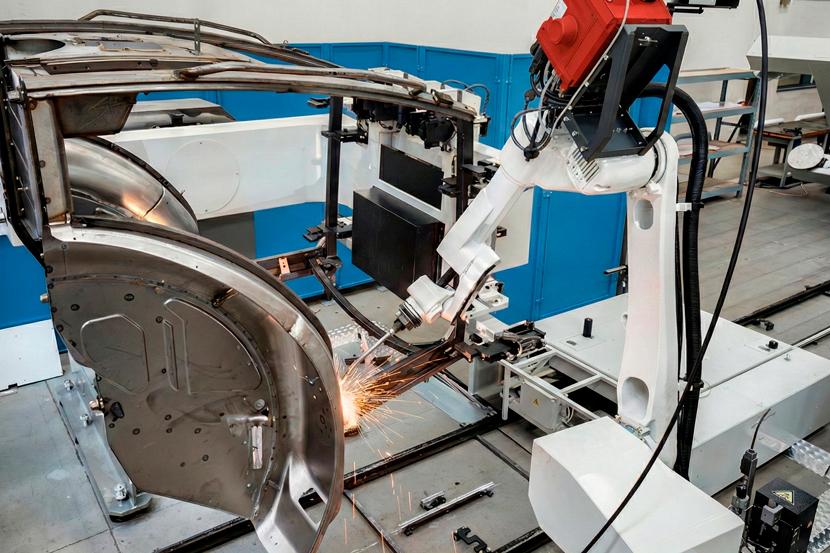
In the field of metalworking, particularly in the production of medium and large welded structures, automation is now a central element for ensuring quality, repeatability and process stability. In this context, Tiesse Robot has developed a robotic cell dedicated to the arc welding of tractor cabins, designed to combine operational efficiency with production flexibility.
The system is built around a single robotic station, where the workflow has been designed to maintain a collaborative balance between human intervention and automation. The cabins are initially assembled and tack-welded by operators, then transferred into the cell via independent motorised trolleys. A lift platform ensures correct positioning of the piece, which is then attached to an orbital positioner with a load capacity of up to 1000 kg and moved into the working position in front of the welding robot.
The Robotic Cell: Collaborative Workflow Between Humans and Machines
The technological core of the system lies in the integration of the Kawasaki Robotics robot and the interpolated rotating orbital positioner. The two systems operate in synchrony, allowing welding with the piece in motion while maintaining the joint in the optimal position throughout the cycle.
A key role is played by the joint-tracking systems, enabling the robot to adjust its trajectory in real time.
From the outset, the Tiesse Robot cell was designed with a high degree of flexibility. The gripping equipment allows multiple versions of the cabin to be handled, with automatic changeover managed by the cell’s control system. This approach minimises manual interventions and allows the system to adapt to different production lines while maintaining high precision and safety.
Digitalisation and Operational Continuity
Alongside mechanical and robotic features, the cell integrates advanced digital solutions: the line supervision system allows the monitoring of the cell’s status and any alarms, records process parameters such as current, robot welding speed, oscillation amplitude and frequency, and makes the data available in formats compatible with company information systems.
Remote assistance completes the setup, enabling rapid interventions and support to ensure operational continuity. Taken together, this solution represents a complete production system capable of managing quality, flexibility and traceability within a single integrated workflow.
Since 1976, Pioneers of Industrial Robotics in Italy
This project coincides with a significant milestone for the Visano-based company, which in 2026 celebrates fifty years of activity in the industrial automation sector. A journey built over time, characterised by technological evolution, specialisation and the consolidation of expertise.
Recent organisational and corporate developments, aimed at strengthening skills and technological partnerships, reflect this same philosophy. They represent a coherent step towards an even more robust structure, capable of handling increasingly complex applications and supporting clients in the development of complete, reliable and long-lasting production solutions.